
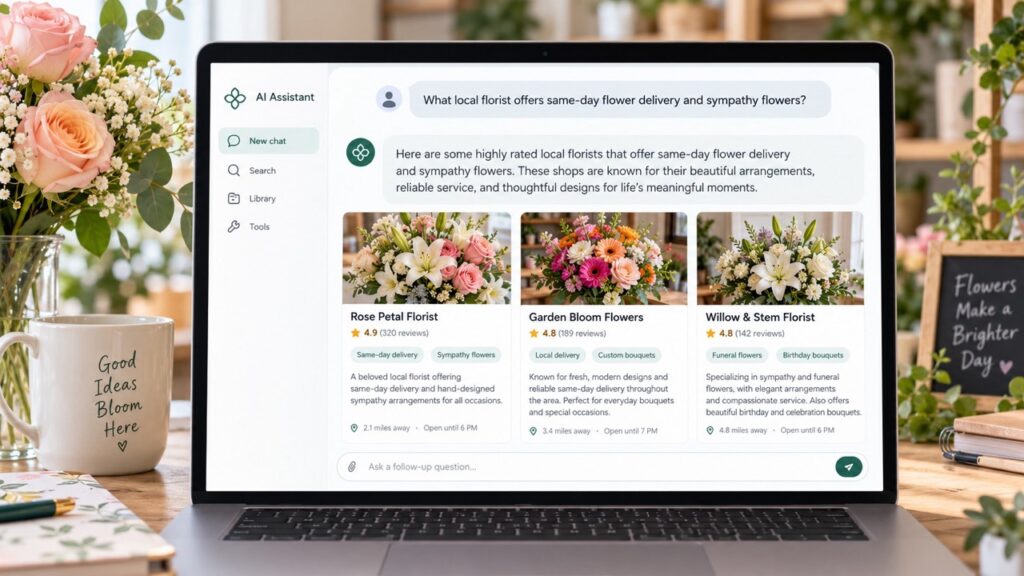
Customers are starting to ask AI tools questions that used to go straight into a search bar:
- What is the best florist near me?
- Who offers same-day flower delivery in my city?
- Where can I order sympathy flowers?
- What local florist has arrangements under $75?
That means online visibility is no longer only about traditional Google search results. Your flower shop may also be evaluated by AI-powered experiences such as Google AI Overviews, ChatGPT Search, and Microsoft Copilot.
The good news is that AI optimization for florists does not require an entirely separate marketing strategy. The same things that help search engines understand and trust your flower shop also make your business easier for AI systems to find, understand, and reference.
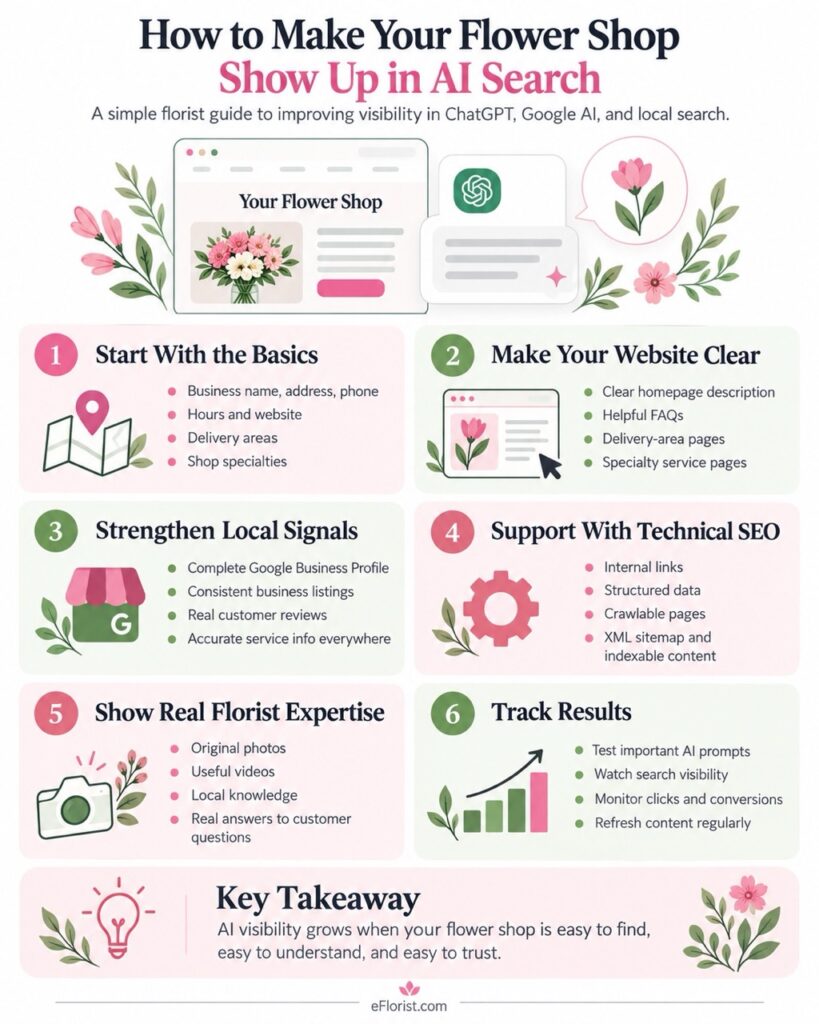
The Short Answer: How Does a Florist Become More Visible in AI Search?
Make your flower shop easy to:
- Find
- Understand
- Verify
- Trust
That means:
- Keep your business information consistent.
- Clearly explain where you deliver and what you specialize in.
- Build useful website content around real customer questions.
- Maintain your Google Business Profile and other listings.
- Earn authentic customer reviews.
- Use clear website structure and structured data.
- Publish real photos, local information, and first-hand expertise.
- Make sure search and AI crawlers can access your website.
- Build mentions and citations outside your own website.
- Keep everything accurate and current.
There is no button that guarantees an AI recommendation, but these steps give AI-powered search systems much better information to work with.
1. Start With the Facts About Your Flower Shop
The first step is simple: define the facts you want search engines, AI systems, and customers to understand about your business.
Confirm the following:
- Business name
- Address
- Phone number
- Website
- Business hours
- Main delivery areas
- Same-day delivery availability
- Important specialties
Specialties might include:
- Sympathy flowers
- Weddings
- Corporate flowers
- Luxury arrangements
- Plants
- Event florals
- Roses
- Designer's Choice
- Same-day delivery
Then check that information anywhere your business appears online.
Your website should not say one thing while Google, Yelp, Facebook, or another directory says something different.
This is also the foundation of the Teleflora eMarketing AI Optimization consultation process: confirm the shop's core business information, service areas, and specialties before optimizing homepage content, FAQs, listings, and other local assets.
2. Make Your Homepage Explicit
Humans can sometimes infer what a business does from a visual website. AI systems should not have to guess.
Your homepage should clearly explain:
- Who you are
- What kind of business you are
- Where you are located
- Where you deliver
- What you specialize in
For example:
Smith Floral is a locally owned florist in Norman, Oklahoma offering same-day flower delivery throughout Norman, Moore, and south Oklahoma City. We specialize in birthday flowers, sympathy arrangements, weddings, and custom floral design.
That kind of description provides clear context to customers, search engines, and AI systems.
Do not bury important business information only in the footer.
For broader website guidance, see eFlorist Website Features and our guide to website design for florists.
3. Answer the Questions Customers Actually Ask
AI search is naturally conversational. Customers increasingly ask complete questions instead of typing short keyword phrases.
That makes helpful FAQs especially valuable.
Examples of Useful Florist FAQs
- Do you offer same-day flower delivery?
- Where do you deliver?
- Can you deliver flowers to funeral homes?
- Do you create custom arrangements?
- Can I order flowers under $75?
- What time do I need to order for same-day delivery?
- Are you open today?
Answer these questions clearly and specifically.
Do not create hundreds of thin pages simply to target slightly different AI prompts. Focus on the questions that genuinely help customers choose your shop.
4. Create Useful Delivery-Area Pages
If you deliver to several important cities or neighborhoods, useful city pages can help clarify where you provide service.
A strong local delivery page can include:
- Delivery availability
- Same-day delivery policies
- Popular product categories
- Local hospitals
- Funeral homes
- Neighborhoods
- Colleges or universities
- Other relevant local destinations
The goal is not to create hundreds of near-identical pages with only the city name changed.
Each important city page should be genuinely useful to someone sending flowers to that area.
For more local SEO guidance, read How to Rank for "Florist Near Me" and "Flower Delivery Near Me".
5. Build Pages Around Your Real Specialties
If a product or service is important to your flower shop, your website should explain it clearly.
Examples include:
- Sympathy and funeral flowers
- Wedding flowers
- Corporate floral programs
- Luxury flowers
- Plants and dish gardens
- Same-day delivery
- Custom floral design
- Event flowers
This gives search and AI systems more context for specific customer questions.
There is a significant difference between:
Florist in Dallas
and:
What florist in Dallas can deliver sympathy flowers to a funeral home today?
The second question requires more detailed business information. Your website should provide that context.
6. Keep Your Google Business Profile Complete and Active
Your Google Business Profile is one of the clearest sources of local business information online.
Regularly review:
- Primary and secondary categories
- Phone number
- Website
- Address
- Business hours
- Holiday hours
- Services
- Business description
- Photos
- Social links where available
Add real photos regularly.
Useful images include:
- Arrangements
- Storefront
- Employees
- Delivery vehicles
- Workroom
- Wedding work
- Seasonal designs
7. Build a Strong Review Footprint
AI systems do not learn about your business only from what you say about yourself.
The broader web matters too.
Reviews provide customers and information-retrieval systems with additional context about your reputation, products, and services.
A healthy review strategy includes:
- Consistently requesting reviews from real customers
- Maintaining your Google review presence
- Responding thoughtfully to reviews
- Monitoring other important review platforms
- Keeping business information accurate on those platforms
If customers repeatedly mention beautiful sympathy arrangements, fast same-day delivery, wedding expertise, or strong service, those reviews also provide real-world context about what your business does well.
Never manufacture reviews or fake mentions.
8. Strengthen Your Listings Across the Web
Your flower shop may appear across many websites and business databases, including:
- Yelp
- Bing
- Apple Maps
- Local directories
- Wedding websites
- Chamber directories
- Florist directories
Keep your business identity consistent across these sources.
Think of your listings as corroborating sources:
| Source | Role |
|---|---|
| Your website | Explains who you are and what you offer. |
| Google Business Profile | Confirms core local business information. |
| Business directories | Provide additional confirmation of your identity and location. |
| Review platforms | Provide third-party context about customer experiences. |
The more consistently your business is represented across trustworthy sources, the easier it is to understand your business as a real local entity.
9. Use Structured Data — But Do Not Treat Schema Like Magic
Structured data helps search engines classify information on a webpage.
Useful schema types for florist websites may include:
- LocalBusiness
- Organization
- Product
- BreadcrumbList
- FAQPage where appropriate
Structured data should accurately reflect information visible on the website.
Do not use schema to make hidden claims or add information that is not supported by the page.
There is also no special "AI schema" required to appear in AI search.
10. Make Sure Search and AI Crawlers Can Access Your Website
This is a technical step that many florists will never need to manage directly, but your website provider should.
Important public pages should be:
- Accessible to legitimate search crawlers
- Included in your XML sitemap
- Internally linked
- Indexable
- Free from accidental noindex directives
- Available with normal successful HTTP responses
ChatGPT Search uses OpenAI's OAI-SearchBot for search discovery. Websites that want to be eligible for discovery in ChatGPT Search should not block that crawler.
Review OpenAI's crawler documentation.
Google's current guidance for generative AI search also emphasizes the same foundational SEO requirements: useful content, crawlability, clear structure, and accurate information.
11. Publish Real Florist Expertise That AI Cannot Easily Reproduce
One of the strongest things a local florist can publish is information that comes from actually running a flower shop.
Examples include:
- What flowers hold up best for summer outdoor weddings in your area?
- What should customers know before sending flowers to a local hospital?
- What happens when a requested flower is unavailable?
- How does your shop handle funeral-service delivery timing?
- What flowers do your designers recommend for fall weddings?
- What should customers know about Valentine's Day delivery cutoffs?
- How does Designer's Choice work at your flower shop?
This type of content demonstrates first-hand experience and is difficult for a generic website to replicate authentically.
Do not fill your website with articles that could belong to any florist in any city.
Publish what your flower shop actually knows.
12. Use Photos and Video as Information, Not Decoration
Search is increasingly multimodal, meaning images and video can contribute useful context in addition to text.
For images, use:
- Descriptive filenames
- Useful alt text
- Captions when helpful
- Relevant nearby text
- Real shop photography
Video topics might include:
- How Designer's Choice works
- What happens after an online order is placed
- How your shop prepares sympathy flowers
- Flower care tips
- Holiday ordering advice
- Your wedding consultation process
Keep important information available in text too, even when you also publish a video.
For image optimization guidance, see Google's image SEO documentation.
14. Do Not Chase AI Hacks
There is a growing list of supposed "GEO" or AI SEO shortcuts.
For local florists, the fundamentals are more important than tricks.
You do not need to:
- Create hundreds of thin pages for slightly different prompts
- Stuff paragraphs with awkward AI keywords
- Create fake third-party mentions
- Publish duplicate content across dozens of websites
- Rewrite every sentence only for AI extraction
- Expect an llms.txt file to suddenly make Google recommend your shop
Google's current guidance says there are no special AI-only technical requirements beyond established SEO practices for appearing in its AI search experiences.
Focus on building the clearest, most useful, and most verifiable representation of your flower shop online.
15. Measure Whether AI Visibility Is Improving
AI visibility should be monitored alongside your existing SEO and website performance.
Useful metrics include:
- Branded searches
- Non-branded local search visibility
- Organic landing-page traffic
- Engagement
- Conversions
- Referral traffic
- Review growth
- Third-party mentions and citations
You can also periodically test important customer prompts in major AI search experiences.
Example Florist AI Search Prompts
- Best same-day florist in [city]
- Where can I order sympathy flowers in [city]?
- What local florist delivers today?
- Where can I order a flower arrangement under $75 in [city]?
- What florist should I use for a funeral in [city]?
- What is the best florist near me?
Track patterns over time rather than focusing on a single AI response.
AI Optimization Checklist for Florists
| Task | Check |
|---|---|
| Confirm business name, address, phone, email, website, and hours. | ☐ |
| Confirm service areas. | ☐ |
| Confirm business specialties. | ☐ |
| Improve homepage business description. | ☐ |
| Add useful customer FAQs. | ☐ |
| Improve important city and delivery-area pages. | ☐ |
| Create useful specialty or service pages. | ☐ |
| Update Google Business Profile information. | ☐ |
| Add real photos to Google Business Profile. | ☐ |
| Keep business listings consistent. | ☐ |
| Request and respond to customer reviews. | ☐ |
| Improve the About Us page. | ☐ |
| Strengthen internal linking. | ☐ |
| Add appropriate structured data. | ☐ |
| Confirm important search and AI crawlers are not blocked. | ☐ |
| Publish real florist expertise. | ☐ |
| Keep social profiles consistent. | ☐ |
| Monitor search and AI visibility over time. | ☐ |
How eFlorist Helps
AI visibility is not a separate marketing channel sitting outside SEO.
It is increasingly connected to the same digital foundation florists already need:
- A strong website
- Accurate local business information
- Useful content
- Business listings
- Customer reviews
- Clear service-area information
- Strong technical SEO
eFlorist helps flower shops strengthen that foundation through florist-specific websites, local content tools, SEO and listings support, reputation management, and digital marketing services.
The goal is simple: make it easier for customers — and the systems helping customers search — to understand why your flower shop is a relevant local choice.
Explore eFlorist Website Features | Explore eFlorist Marketing Packages | Contact eFlorist
Frequently Asked Questions About AI Search for Florists
Can my flower shop appear in ChatGPT Search?
Yes. Public websites can be surfaced in ChatGPT Search when their content is relevant and accessible to OpenAI's search crawler. Inclusion or placement is not guaranteed.
How do I get my florist into Google AI Overviews?
There is no separate submission process for Google AI Overviews. Google recommends following established SEO best practices, including useful original content, crawlable pages, clear site structure, a good page experience, and accurate local business information.
Do florists need special AI schema?
No. There is no special AI schema required for Google generative search. Use appropriate structured data that accurately represents visible website content.
Does Google Business Profile affect AI visibility?
Google Business Profile is an important source of local business information. Keeping your profile accurate and complete can help Google understand important details about your flower shop, including location, hours, services, and business identity.
Do reviews help AI understand my flower shop?
Reviews and third-party business information can provide additional context about your business, reputation, and specialties. They are also useful to potential customers evaluating your flower shop.
Should florists create an llms.txt file?
It is not required for Google AI search. Google's current guidance does not identify llms.txt as a special ranking requirement for its AI search experiences.
Should I optimize my florist website separately for ChatGPT and Google?
The fundamentals overlap heavily: crawlable pages, clear business facts, useful content, trustworthy supporting information, local signals, and strong technical SEO. For ChatGPT Search specifically, websites that want to be eligible for search discovery should ensure OAI-SearchBot is not blocked.

13. Keep Your Social Profiles Consistent With the Same Story
Your website, Google profile, and social accounts should reinforce the same basic business identity.
Keep social profiles current with:
Then use social content to demonstrate those specialties through real arrangements, events, staff, customer stories, and local work.
Consistency across platforms makes the business easier for customers and information systems to understand.